TSUMIKI
Build a World. Learn English.
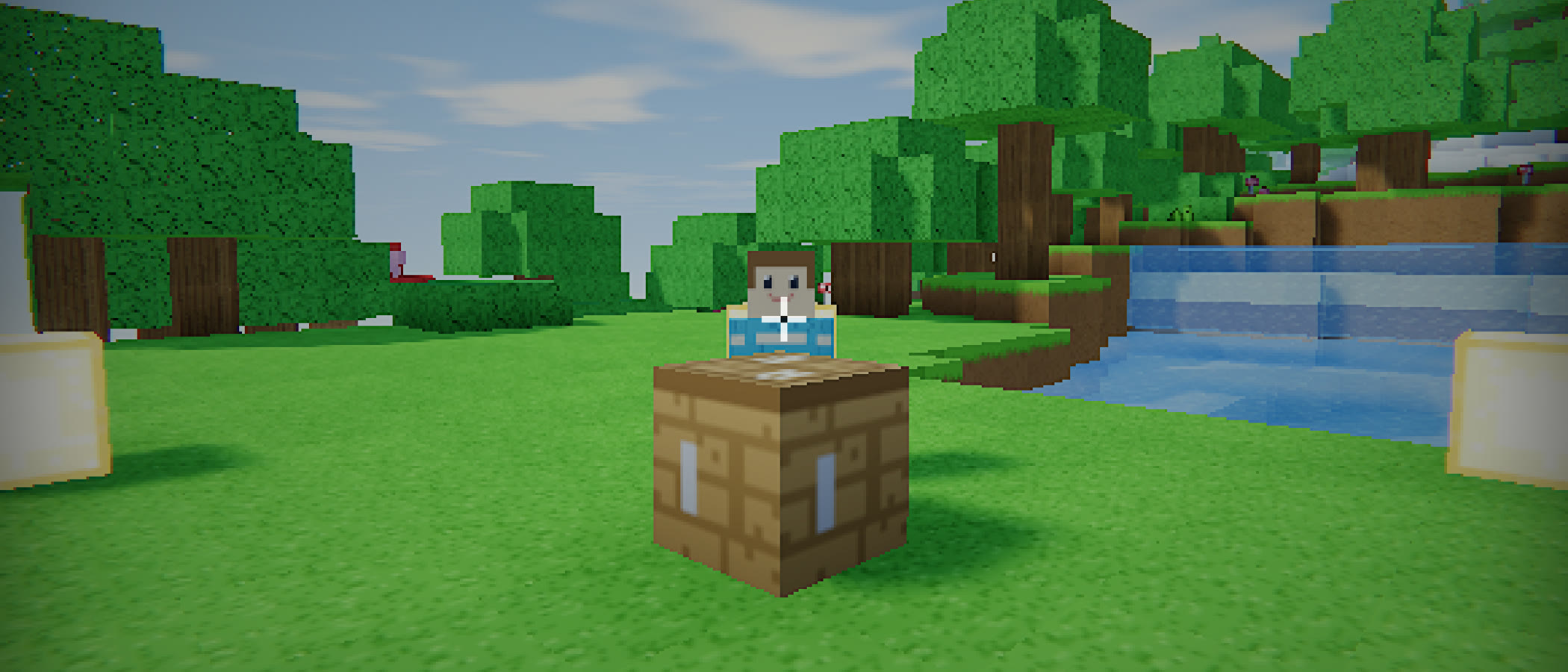
Tsumiki (つみき — building blocks) is a voxel world built for a Japanese eight-year-old who loves Minecraft and is learning American English. The design premise is one sentence: the world is not decorated with English, the world is the English. Every block is tied to exactly one vocabulary word, and hitting it says that word out loud.
Origin Story開発の背景
Educational games usually bolt a lesson onto a game and hope the child tolerates the lesson to get at the game. That trade is visible to an eight-year-old within about ninety seconds. So nothing here is a lesson: break a block and it names itself in an American voice, throws the word across the middle of the screen with the Japanese under it, and follows with a short sentence using it. Break forty blocks in an afternoon and you have heard forty English nouns in context without anyone calling it study.
How It's Builtつくり方
The sentence engine is the part that took the real work. There are around 14,000 sentences, 100+ per word, and they are neither hand-written nor loosely generated. Each of the 125 words carries its own grammar — countable or not, its real plural, whether it takes an article — plus adjectives that are actually true of it, verbs you really do to it, and places you really find it. Sentence frames combine those, so the output is correct by construction: 'a sand' and 'two sheeps' cannot be built. Hearing a word in forty different frames teaches the word; hearing the same frame forty times only teaches the frame.
Engineering Notesエンジニアリングノート
Sentences correct by construction
Each of the 125 words carries its own grammar — countable or not, its real plural, whether it takes an article — plus adjectives that are true of it, verbs you do to it and places you find it. Frames combine those into 100+ sentences per word, so 'a sand' and 'two sheeps' are not filtered out afterwards; they cannot be generated in the first place.
A deterministic infinite island
Everything about a chunk is a pure function of its coordinates and the seed, which is what lets chunks be built in any order, thrown away and regenerated identically. Features straddling a boundary work because every chunk stamps the features of its whole 3×3 neighbourhood and keeps only the blocks landing inside itself. Only her edits are saved, so the file stays kilobytes.
Water as a medium, not a surface
The scene behind the water is sampled and refracted through the wave normal, the depth buffer says how far behind it is so colour is absorbed over distance, and foam appears wherever that distance goes to nothing — which is exactly where a shoreline is. Real planar reflections come from a mirror matrix, so land in the sea is genuinely upside down; ponds and waterfalls are off that plane and take a sky reflection instead of one belonging somewhere else.
Every asset drawn at boot
No image or audio files ship at all. Textures are painted in canvas 2D at 16×16 and uploaded as layers of an array texture, sounds are synthesised with Web Audio, and the voice is the browser's own synthesiser forced to en-US and slowed to 0.82 — at normal speed the consonant clusters that are the whole difficulty arrive as a single sound.
Galleryギャラリー
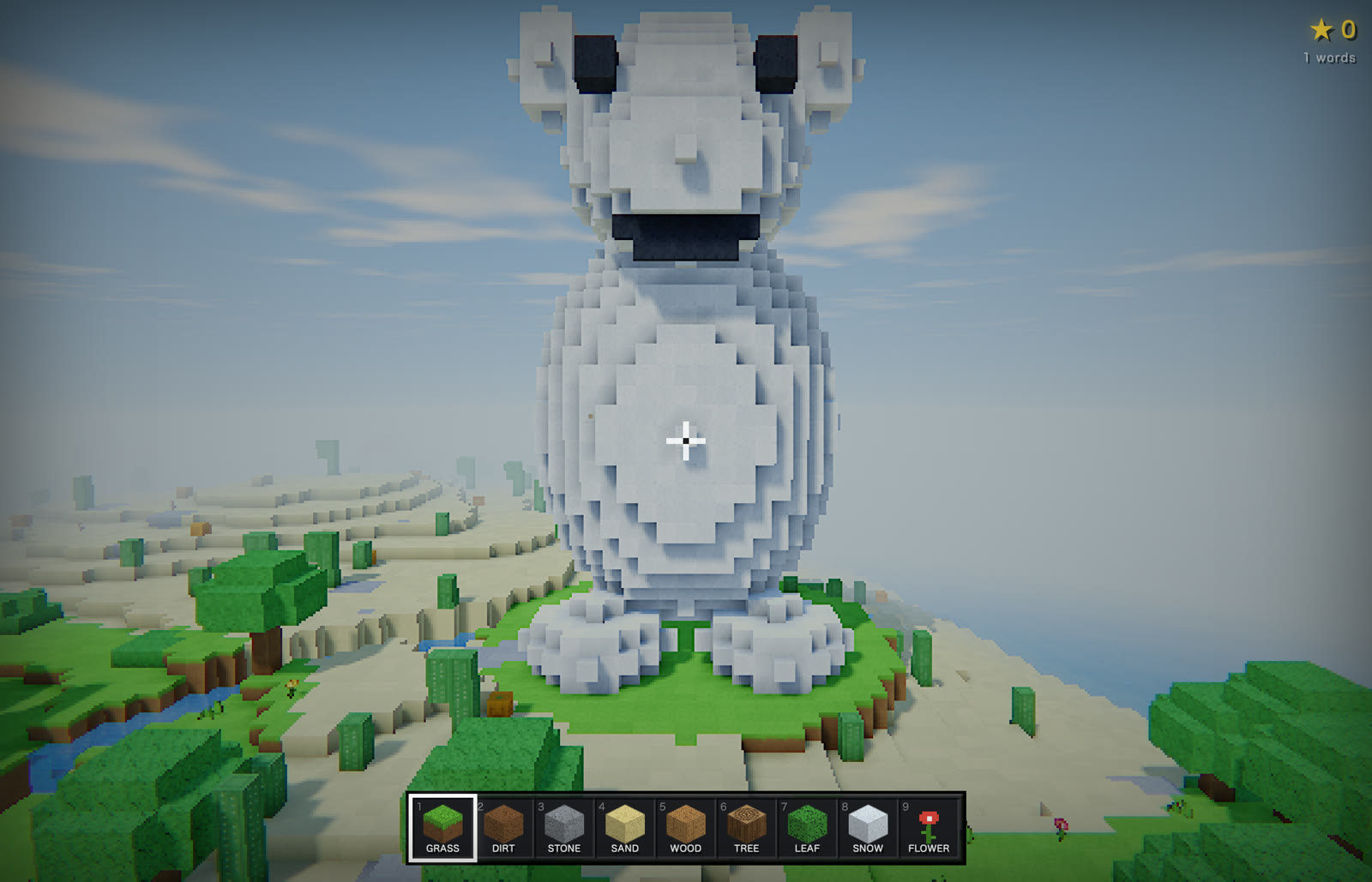
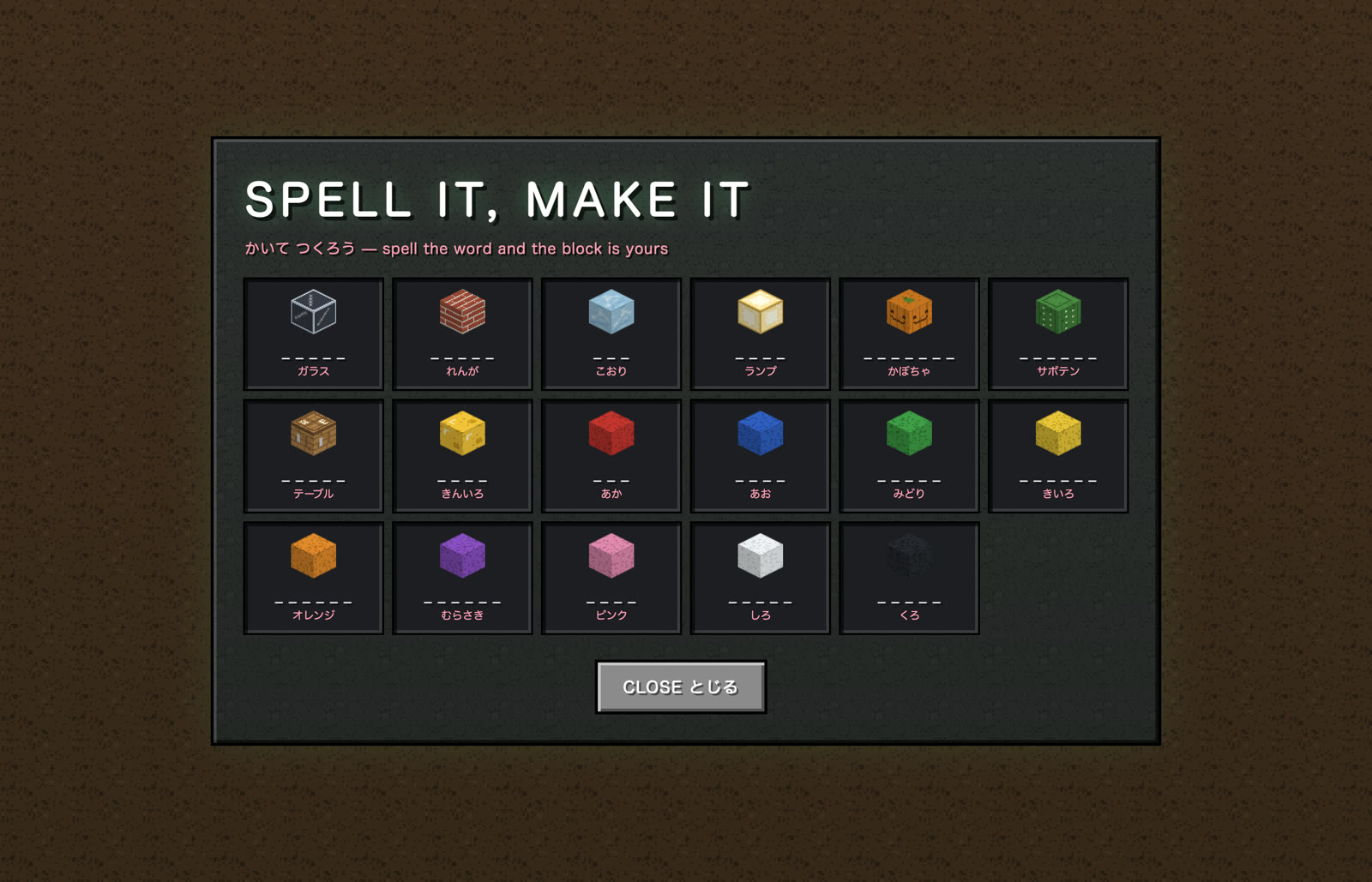
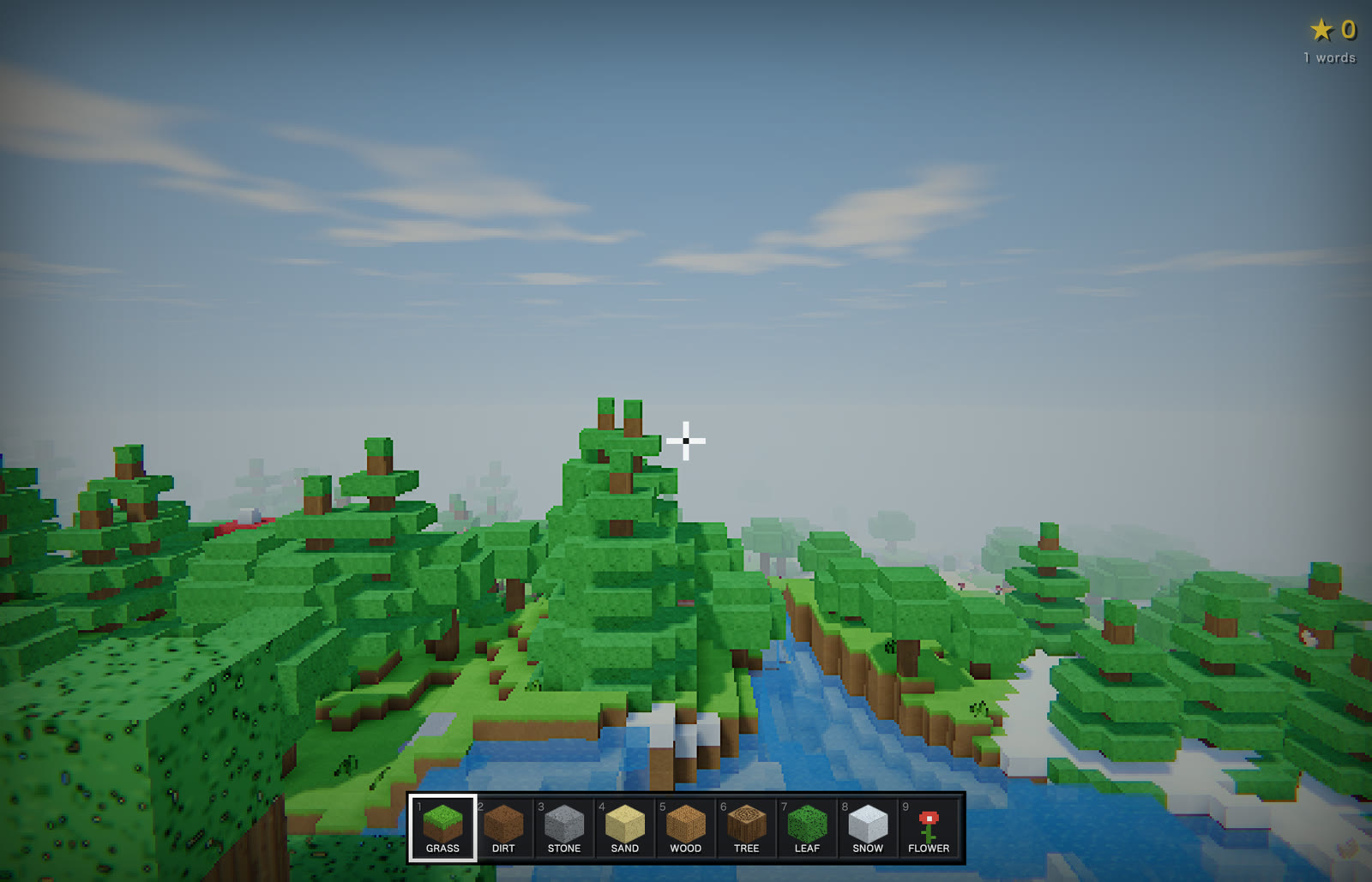
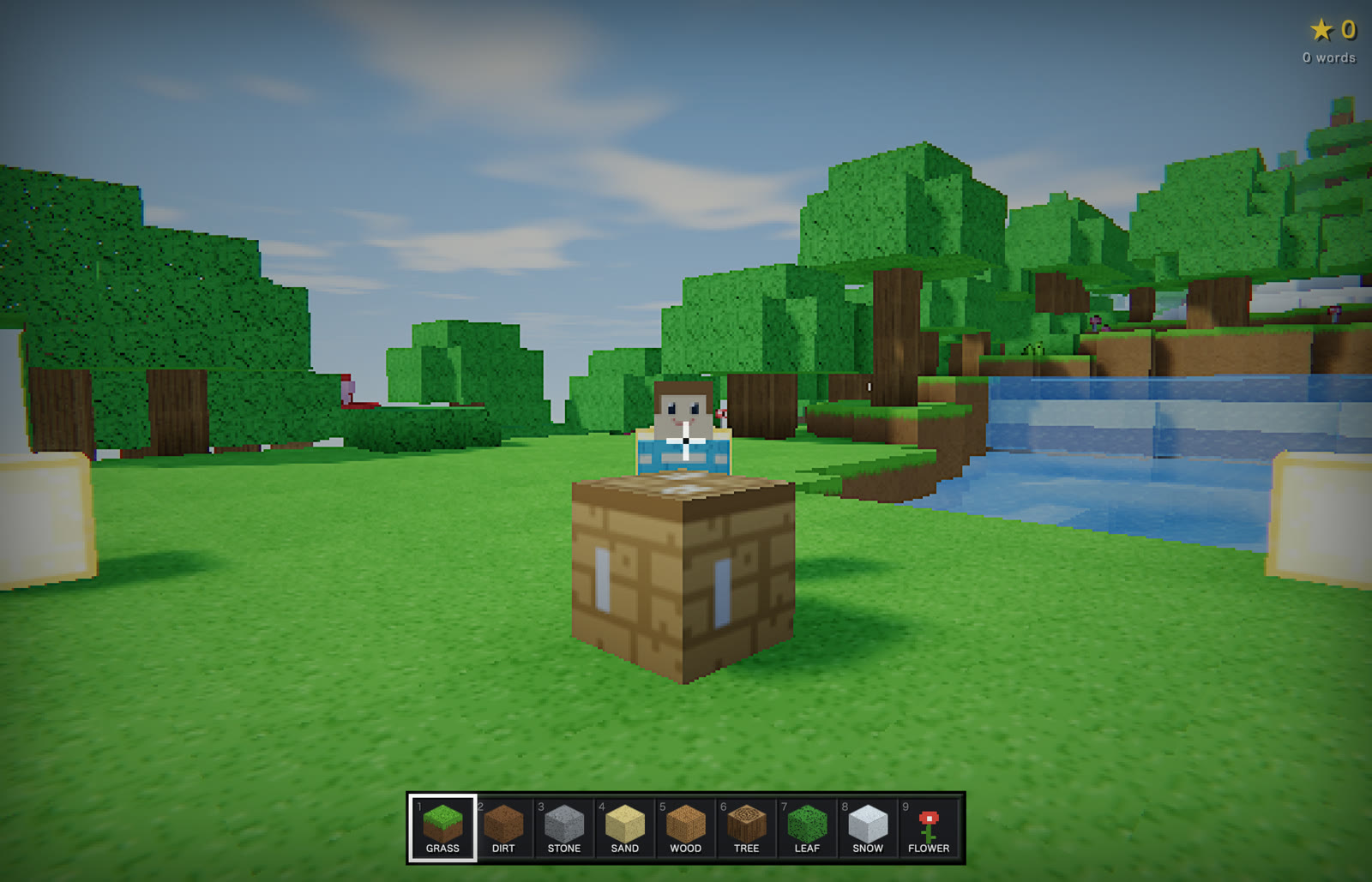
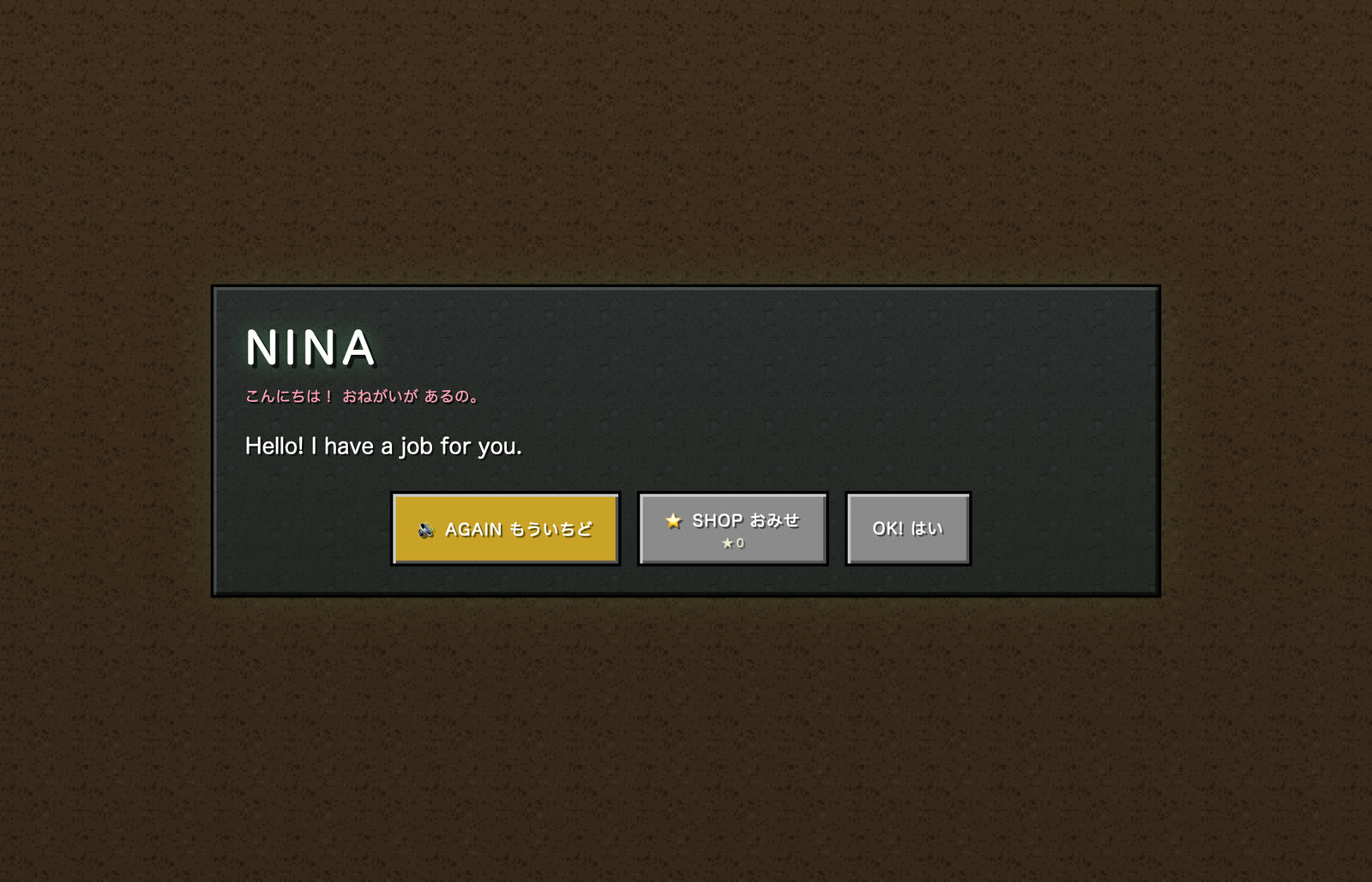
Every design decision here answers to one person who will tell you, instantly and without diplomacy, when something is boring. That is a far better specification than any pedagogy — the English has to survive contact with a child who came for the blocks.
What It Does主な機能
Spell It, Make It
The crafting table does not take materials, it takes spelling. Click the scrambled letters in the right order and the block is yours to build with. The lamp, the gold and all nine colours are locked behind their own names — so the reason to spell is the reason she already has: she wants the glowing block.
Nina, the Word-Keeper
She stands by the crafting table and asks for things — 'Bring me three flowers', 'Place five red blocks' — in a sentence pinned to the corner for as long as the job is open. Fetch quests are a thing a child will do forty times, which is forty readings of an English sentence. After her twelve written jobs she invents them forever, and every third one is a preposition: put a lamp ON the table, a flower UNDER it. A block world is the only medium where that can be checked rather than merely said.
Kaede, Who Speaks Japanese
A companion who walks with her and runs everything the other way — Japanese in, English out — including a word-order puzzle for 'A RED FLOWER', because Japanese has no articles and no reason to expect one. Two approaches in three she simply talks: about the biome, the weather, the animal that just walked past.
Word Chests
Scattered across the island, about one chunk in six. Each is a picture and four words, spoken aloud before they are readable. Get it right three times and the word earns a star.
Stars Buy Things, Not Points
Stars are not a score. They buy carrots that tame animals, a saddle so one can be ridden, faster boots, longer reach, blocks without spelling them, fireworks, and a crown that Nina then actually wears.
Nothing Can Be Failed
A wrong answer is removed from the choices and the right word is said again. No health, no monsters, no fall damage, no way to die. The worst outcome available is a swim.
Endless, Deterministic World
Chunks are generated from the seed as she walks toward them and dropped behind her — no edge, no grey wall. Seven biomes decide the ground and what grows on it, with huts, campfires, stone circles, ruins, and, rarely enough that finding one is an event, two white giants twenty blocks tall.
Plays on an iPad
Touch controls appear automatically. The left thumb is a floating stick that centres wherever it lands, so you never have to look at your hands. Break and place are deliberately separate buttons rather than tap-versus-hold — a coin flip between digging and building is the most annoying thing this game could do to a small pair of hands.
Where It Stands現在地
Tsumiki is live and playable in a browser, and on an iPad it adds touch controls and runs full-screen from the home screen. It is finished in the sense that matters — it is being played by the person it was built for. The vocabulary is data, so more words and more of Nina's job types extend the same loop rather than needing new machinery.
Plain ES5 JavaScript and WebGL 2 — no engine, no framework, no build step, no package manager and no asset files. Script order in index.html is the dependency graph. Every texture is drawn in code with canvas 2D at 16×16 and uploaded as layers of a 2D array texture, which is also where the menu wallpaper comes from; every sound is synthesised with the Web Audio API; the voice is the browser's own speech synthesiser, forced to en-US and slowed to 0.82 for single words, because the consonant clusters are the whole difficulty and at normal speed they arrive as one sound. The world is rendered into a buffer a few hundred pixels wide and blown up chunky by CSS, then run through a full pass: per-pixel sky from the view ray, per-vertex ambient occlusion, real planar water reflections via a mirror matrix, refraction and depth-sampled absorption through water, aerial perspective that hides both the island's edge and the chunks still being built, and a post chain of light shafts, two-pass bloom, ACES tonemap, unsharp mask, chromatic aberration and scanlines. Only her edits are saved — the generator is deterministic, so the island returns identical and the save file stays a few kilobytes however long she builds.